
On August 15, 2026, the 1996 USA Women’s Basketball Team was enshrined in the Naismith Memorial Basketball Hall of Fame. It was 30 years ago, on August 4, 1996, that the team captured the gold medal and the country’s spirit. But the team’s pursuit of gold and global excellence started long before the first games tipped off in Atlanta. And, at about that same time, I had started my own pursuit—not for a gold medal or anything global, but for a master’s degree in sport management. By no means do I claim that my pursuit of a degree was as monumental as the ’96 Olympic team’s journey, but at the time I did not realize that my own search for where I fit professionally was unfolding alongside a team whose journey would help redefine the future of women’s basketball. Eventually, my path did intersect with theirs that summer in Atlanta.
Some context here might be helpful. My master’s degree was a one-year program, with fall and spring semesters that included courses like sport law, sport marketing, event management, sociology and sport, and perhaps my greatest challenge, accounting and economics in sport. Meanwhile that fall and spring, legendary coach Tara VanDerveer and the U.S. Women’s National Team embarked on a national tour that included games against the top collegiate women’s basketball teams in the country and international stops abroad against top talent in Russia, Ukraine, Australia, Canada and China, amassing an astonishing 52-0 record. I started my master’s degree because I had yet to establish a professional presence, a career that would set me up for the future. USA Basketball sent the U.S. Women’s National Team on a tour to prepare for the Olympics, grow public interest, and test the market for professional women’s basketball.
To this point, my path and the U.S. Women’s National Team’s path were running parallel, not intersecting yet. To complete my degree, I had to meet the internship requirement by the end of the summer. I was fortunate that I had worked previously as an intern with the Women’s Basketball Coaches Association and met Dan Mannix, Director of the 1996 Olympic and Paralympic Basketball Competition. As an intern, I once drove Dan from downtown Atlanta to our WBCA offices in Lilburn for a meeting about Olympic volunteer recruitment. During that car ride, Dan kindly offered to review my resume and encouraged me to keep in touch. I did, and when it came time to find my internship placement, Dan made an offer I am forever grateful for: the opportunity to work with his ’96 Olympic & Paralympic staff. Growing up, attending the Olympics was always a bucket list item; I don’t know that I ever dreamed of working on the staff. Additionally, the Olympics were, at the time, the primary way I watched women’s basketball. And now I was going to Atlanta, and so was the 1996 Women’s Basketball National Team.
This felt great, but it was also a tremendous test to work one of the largest sporting events in the world. After completing the event management course for my degree, event management had become a passion because it combined preparation, teamwork, attention to detail, and the satisfaction of helping create an experience for others. In many ways, that passion connected to what I had always loved about basketball: each person contributing an important role and skill set toward something bigger and meaningful. This internship experience would test not just my endurance, knowledge, and teamwork, but also my passion for sport management.
The stakes for the U.S. Women’s National Team heading to Atlanta were a little different. By the time they arrived, they had already captured the attention of the nation, drawing media and fan attention everywhere they went and setting the bar for women’s basketball. On the surface, it would seem their test was to win the gold medal, but there was more to it than that. Their Olympic pursuit was unfolding at a moment when women’s basketball was on the cusp of a professional relaunch, with the American Basketball League preparing to launch in fall 1996 and the WNBA approved a league for a summer 1997 debut. So, the intent of the tour was to do more than give the team a chance to gel and prepare for the Olympics. In fact, when players received their invitation to be part of the team and tour, they were told that participating did not guarantee them a spot on the Olympic team; although they all did, with one additional teammate, Venus Lacy, added to the squad after the tour.
The tour was something never done before, created from scratch, so to speak, and part of its purpose was to test whether professional women’s basketball was viable from a business, marketing, and entertainment perspective. In that sense, the public response, and then the announcement of the WNBA, showed just how successful the tour had been. But still, the U.S. had lost in 1992, and for a league to succeed it needed to say it was comprised of the best players. For any doubters that still existed, would the same professional momentum have followed without that gold medal? It is impossible to know, but the question reveals just how much seemed to be riding on that moment.
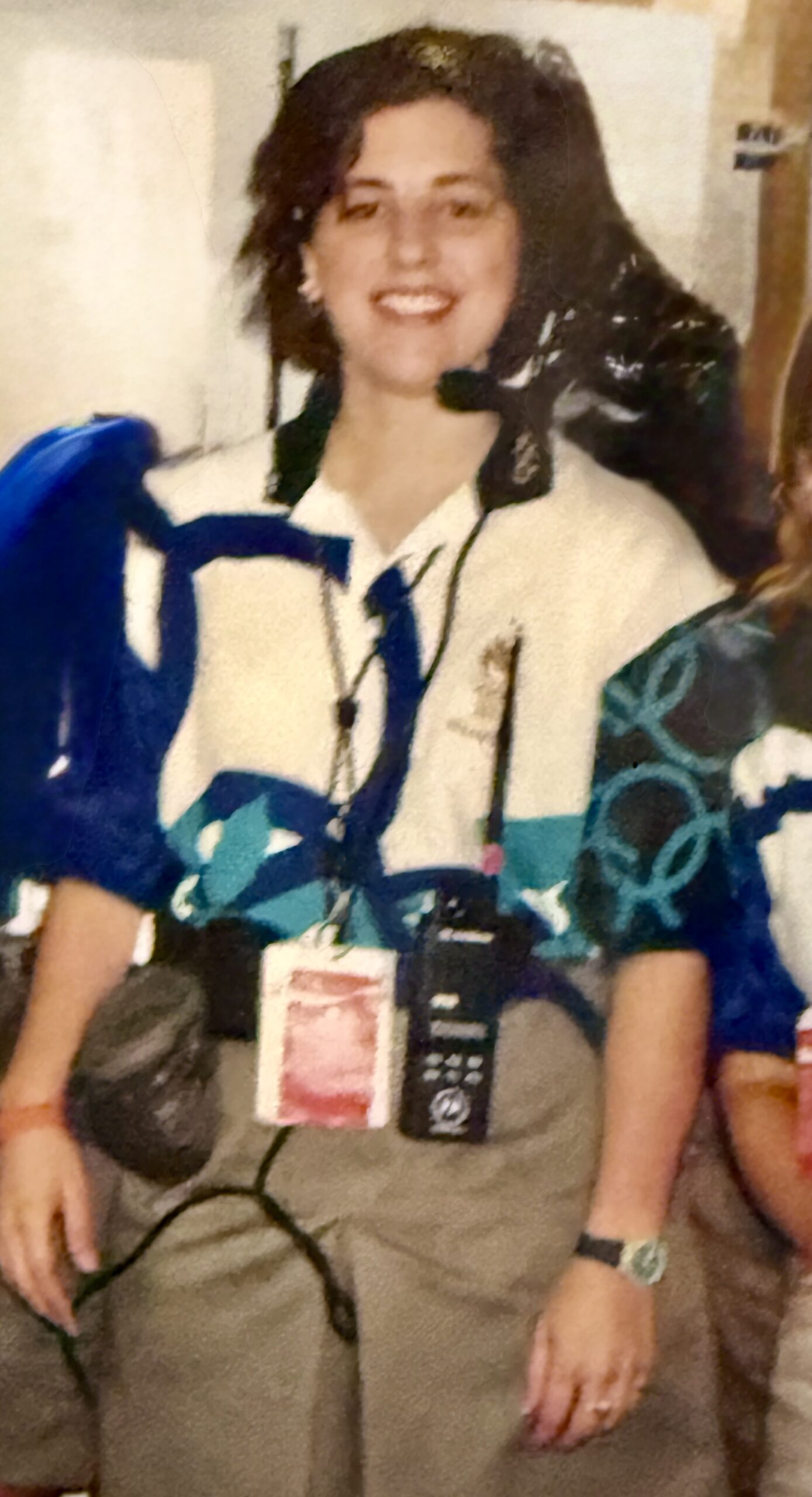
Having the opportunity to stand courtside at the gold medal game and witness the crowd and the emotion-filled environment—the signs reading “This is the real Dream Team,” the U-S-A chants, the standing ovation that lasted the entire gold medal ceremony—I am not 100% sure that gold was absolutely necessary (but it sure helped) for where we are today. Instead, gold was the reward manifested by the deep commitment and sacrifice of the players and coaches. Over 32,000 people cheered and chanted for these women and this team that day. I had never experienced anything like it at a women’s basketball game. I remember standing there, just looking around and having chills. This, the last day of the Olympic Games, was the culmination of my internship. Although I was present in that moment with my own feelings and sense of pride as a former women’s basketball player, I definitely did not comprehend that I was witnessing one of the most important journeys in women’s basketball history. Thirty years later, I understand more fully what I was standing next to that day: not only a gold medal team, but a turning point for women’s basketball and, in a quieter way, a turning point in my own life.
I don’t claim that my journey was ever as challenging or culturally significant as the 1996 Women’s Basketball Team, but maybe in the smallest way, it is connected to theirs simply because that team made me feel connected and deeply passionate about pursuing a dream. Looking back now, the lyric from Celine Dion’s Power of the Dream performance at the 1996 Summer Olympic Games Opening Ceremonies feels especially fitting: “…There’s nothing ordinary in the living of each day. There’s a special part every one of us will play…” And perhaps that is what thousands of others felt along the way on each one of the team’s tour stops: the joy, exhilaration, and power of witnessing what a shared dream can become!
Thank you to the 1996 USA Women’s Basketball Team: Coach Tara VanDerveer, Assistant Coach Ceal Barry, Assistant Coach Nancy Darsch, Assistant Coach Marian Washington and players Jennifer Azzi, Dawn Staley, Lisa Leslie, Carla McGhee, Venus Lacy, Rebecca Lobo, Teresa Edwards, Ruthie Bolton, Katy Steding, Sheryl Swoopes, Katrina McClain, and Nikki McCray-Penson!
For those interested in learning more about the journey of the 1996 USA Women’s Basketball Team and their impact, I strongly recommend you check out “Dream On,” part of ESPN’s 30 for 30 docuseries.
0 Comments